

Manufacturing companies
When electricity makes up a significant share of production costs.
Battery storage solutions are relevant for companies that consume large amounts of electricity or depend on an uninterrupted power supply.
When electricity makes up a significant share of production costs.

When managing loads, EV charging needs and peak power spikes matters.

When power supply stability is critical for process safety, minimizing defects/failures and reducing downtime.

When electricity demand is high or variable, and solar energy can be used more efficiently for farm buildings, cooling, drying, irrigation and other processes.

When servers and infrastructure require uninterrupted power, a battery system reduces the risk of downtime and helps manage energy costs.

To store the excess solar energy produced during the day and use it when its value is highest.
A battery lets you store energy when it is cheaper and use it when the electricity price or peak power demand is highest.
The battery can act as a backup power source for critical loads, reducing the risk of downtime, production disruptions or IT system failures.
A battery storage system helps smooth short-term power spikes, optimize connection-point loads and avoid excessive peak power charges.

The battery stores surplus solar generation and lets you use it in the evening, during peak hours or whenever its value is highest.
Under the right conditions, larger energy storage systems can be integrated into arbitrage or balancing markets via a BRP / aggregator. This is most relevant for larger systems (>500 kW).
More efficient energy use, less wasted energy and better use of solar power strengthen your company's sustainability position.
A commercial and industrial energy storage system, also known as a C&I BESS (Battery Energy Storage System), stores electricity in batteries and supplies it to your company’s network when it is needed most.
The system can be used to reduce electricity costs, optimize peak power, make better use of solar generation, provide backup power or participate in energy markets.
Energy storage systems are usually modular – from cabinet-type units to containerized systems. The right size is selected based on your company’s electricity needs, required power, capacity and duration.
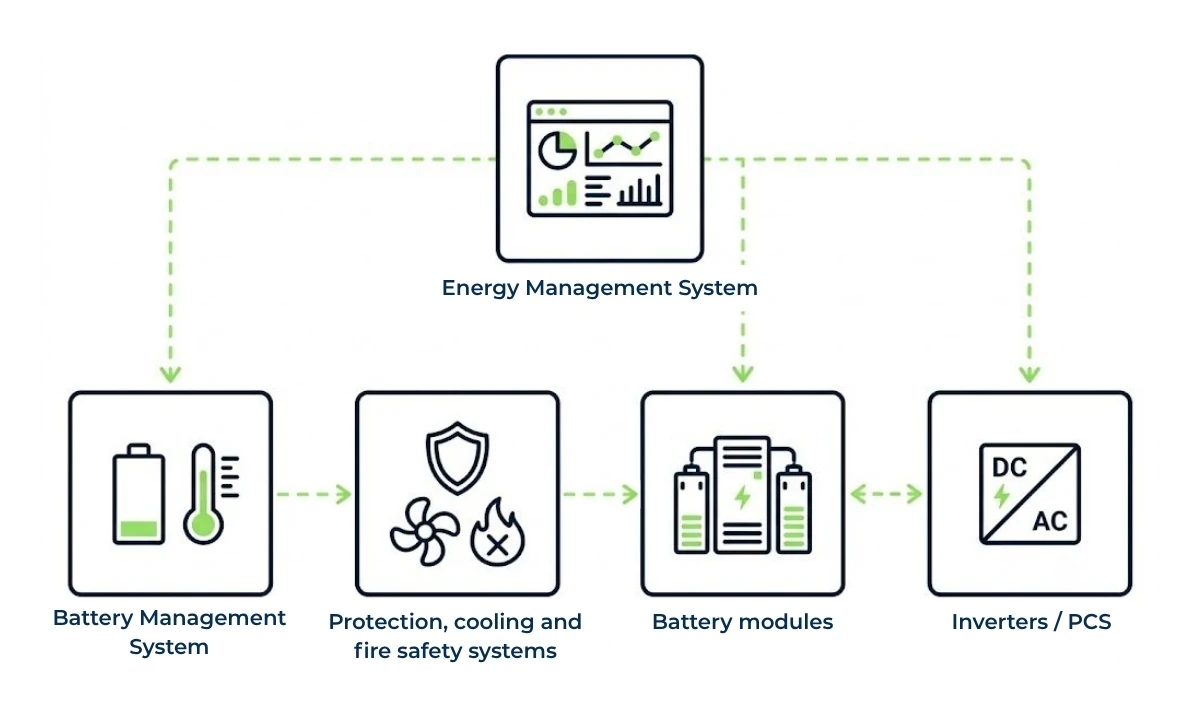
Battery modules – store electrical energy.
Inverters / PCS – convert energy between DC and AC.
EMS (Energy Management System) – optimizes charging, discharging and system operation.
BMS (Battery Management System) – monitors battery safety, temperature and operating parameters.
Protection, cooling and fire safety systems – ensure safe operation.
The payback of an energy storage system depends on your company’s electricity consumption profile, connection capacity, peak moments, tariff structure, solar generation, BESS system size, financing terms and the possibility to participate in arbitrage or balancing markets.
The typical payback period is 2–5 years, depending on the consumption profile and financing terms. We will calculate it specifically for your case.
Energy is stored during cheaper hours and used when electricity is more expensive.
The battery helps smooth short-term consumption spikes and reduce peak-power-related costs.
More of the electricity generated by your solar plant is used within the company instead of being exported to the grid.
Given suitable technical conditions, the system participates in arbitrage or balancing markets.
The battery supports critical loads during power supply disruptions, eliminating interruptions within a fraction of a second (UPS).
The battery maintains critical loads during power disturbances when production lines, refrigeration systems, laboratory equipment or other sensitive processes must be protected.
If your company already has or is planning a solar power plant, an energy storage system helps increase its value. Surplus solar energy generated during the day can be stored and used in the evening, during peak hours or when the market price of electricity is higher.
REEI can help you evaluate both integrating a battery with an existing solar plant and implementing a new hybrid solution. In that case we assess the solar plant’s capacity, your consumption profile, grid connection conditions, battery size and payback scenarios.
For businesses looking for solar power plant or photovoltaic system equipment, we also offer solutions through our specialized e-commerce catalog, GoSolar Shop. We can always offer more than you see in the catalog – get in touch and we will prepare offers for whatever interests you.
REEI works as an independent energy storage system integrator.
This means we select the solution based on your company’s needs – not just based on single manufacturer’s limited technology offering.

We analyze 15-minute or other electricity consumption data, load profiles, peak moments and tariff structure.

We simulate the right BESS configuration, system power, capacity, operating strategy and payback scenarios.

We select battery modules, inverters / PCS, EMS / BMS, protection, switchboards, transformers and other required components.
We coordinate the technical design, ESO / Litgrid approvals, metering, SCADA and the official grid connection.

We install the system, run tests, configure the EMS, and provide remote monitoring plus warranty and post-warranty maintenance.
Process
We discuss your company’s energy consumption situation, goals, existing or planned solar power plant, electricity costs and key questions about energy storage.
We collect electricity consumption data (access can be shared), load profiles, tariff structure, connection conditions and information about existing or planned energy infrastructure.
We select a preliminary BESS configuration, assess the investment size, payback and savings potential, and prepare a proposal with the equipment specification, project budget, implementation schedule and maintenance terms.
We install the system, run tests, coordinate with ESO / Litgrid, configure the EMS and provide remote monitoring and maintenance.
The value of an energy storage system comes not only from the battery but also from managing it intelligently. The EMS can automatically adjust charging and discharging based on electricity prices, consumption peaks, solar generation and your company’s operational priorities.
Given suitable technical conditions, larger systems can be integrated into arbitrage or balancing markets via a BRP / aggregator. In that case the battery not only cuts costs but also generates an additional revenue stream.
Charging when electricity is cheaper and discharging when the price is higher.
Participation in FCR / aFRR / mFRR markets through a suitable market partner.
Remote monitoring, automated control rules, event notifications and performance reports.

REEI is not tied to any single manufacturer's technology, so for every project we can select the most suitable solution based on technical, financial and operational criteria.
We work with trusted technology manufacturers, EPC partners, contractors and market integration partners so that your energy storage system is not only installed, but also properly managed, maintained and aligned with your real business needs.
Client reviews
FAQ
Common questions from businesses looking to integrate BESS solutions for their operations.
We design and implement behind-the-meter battery energy storage systems (BESS) that help companies reduce electricity costs, improve energy reliability, and achieve sustainability goals.
We help businesses secure long-term, cost-stable renewable energy supply through PPAs and hybrid energy solutions, aligning sustainability goals with commercial performance.
Yes. We assist in identifying funding instruments, subsidies, and financing options available for energy efficiency and flexibility projects in the Baltics and EU.
System capacity depends on your energy profile, consumption peaks, and production patterns. Our team performs an initial analysis to recommend the optimal technical and financial configuration.
Battery energy storage is becoming increasingly relevant for companies that want to reduce electricity costs, make better use of their own solar energy and increase operational resilience. Commercial and industrial energy storage systems help manage electricity consumption based on the company’s actual load profile, cut peak-hour costs and provide greater control over energy decisions.
A properly selected battery energy storage system can be integrated with a solar power plant, the company’s internal network, an EMS platform and, under the right conditions, market integration partners. The battery then becomes not just a backup power source but an active energy management tool.
When choosing a BESS solution for business, it is important to evaluate not only the equipment price but also grid connection conditions, connection capacity, peak loads, solar generation, the potential increase in self-consumption, CAPEX / OPEX, payback scenarios and long-term maintenance. That is why every project should start with consumption data analysis and technical-financial modelling.
REEI helps businesses evaluate, design and deliver energy storage systems from initial analysis to a working solution. This allows companies to make decisions based on concrete electricity consumption, cost and payback calculations rather than general assumptions.
